Staying with the Divine.
When we practice the yamas and niyamas as best we can, it releases us from attachment. The desires that cause chitta vritti are cleared and make a way for us to fill the space with thoughts of Isvara. Isvara is defined as God or the Divine, but also as the transcendental, Universal Self. When one dedicates his actions and devotes his thoughts to Isvara, then bhakti (adoration, a special love) flows through him and he realizes spiritual illumination. This is the goal of Isvara pranidhana.
This is a concept that may be easy to spell out in black and white, but hardest to grasp. Desikachar simply states that if you are practicing the other observances, "let it suffice that we know we have done our best...leave the rest to a higher power."
But if you find yourself wanting to do more to go with Isvara, consider Satchidananda's explanation. In his commentary of the Yoga Sutras, he says that Isvara pranidhana is not just dedication to the Divine, but to humanity. He adds humanity because it is a part of the Divine that is tangible for us. God is not sitting, waiting for offerings from us. The universe is God, our world and everything in it is God, our humanity is God. When we dedicate our lives to benefit humanity, we dedicate ourselves ultimately to the Universe.
Kathy asked us to list 100 things we do that is Yoga. If a student has already begun to establish Isvara pranidhana, she could make a list in moment by just detailing her morning activities. Everything around us is Divine. Once you begin to appreciate this, you can choose to regard "work" in a different light. Handle everything with consideration and respect and dedicate your attention to each task you perform. Focus on it, rather than multitask your mind to think of several things at once. That makes everything we do Yoga and appreciate everything as Divine.
I wrote that one act I do that is Yoga is folding laundry. I used to loathe folding laundry. It took me away from other activities that I found more pleasurable. I would fold it quickly and stuff it into a basket. Sometimes the laundry did not make it back into drawers before I started pulling things out of it to wear. Sometimes I would not even match socks and fold underwear.
Recently, I began to change my attitude toward folding laundry. I now put my attention on how I fold each piece and place it in a specific pile (IE. older son's pants, younger son's pants, my pants, husband's pants, likewise with shirts and other items). If I grab a sock, instead of throwing it back in a basket, I place it aside and wait for the match to show up as I keep folding. The act of folding is a mantra, it is Zen. I zone out of life a bit as I work like a machine to finish the task.
Once I am completely finished, I can see it all before me, neatly organized and folded. It is actually quite beautiful compared to the disarray. An organized batch of laundry is much easier to put away and socks are easy to find when I need them. I find bhakti in the discipline of finishing the task of laundry. (Now, if I can just practice Isvara pranidhana in cleaning bathrooms, I might just attain samadhi!)
Wednesday, December 31, 2008

Tuesday, December 30, 2008
More thoughts on Svadhyaya
Although I wrote about many ways to practice svadhyaya beyond just studying sacred texts, I do recommend reading the Bible, Torah or the Quaran, or other religious book if you have not done so already. Read them for yourself and gain your own opinion without the filter of priests or extremists.
In my struggle with understanding God, I opted to read the Bible. I got through the Old Testament and was able to form my own conclusions and opinions. The main thing I realized is that this is not the word of God. This is a collection of stories from people who interpret what they know as God.
The people who wrote the Bible certainly had good ideas about how to live your life in harmony with others. I can pick these ideas out and apply them to my life in positive ways. But what the messages lacked was a way to find peace from within. They used Fear of God to keep people in harmony. I still need to read the New Testament, and I hope to find less Fear...we shall see.
Monday, December 29, 2008
Thoughts on Svadhyaya
Self-study. Self-reflection.
Feurerstein paraphrases a quote from the Shata-Patha-Brahmana that sums up svadhyaya very well. "The study and interpretation of the sacred lore are a source of joy. The serious student becomes mentally focused and independent of others...He controls his senses and delights in the One. His insight and inner glory grow, and he acquires the ability to promote the world."
Yoga texts (such as Yoga Sutra 3.44) instruct you to study sacred texts for true self realization. But you can study any books, particularly those that educate and offer ways to help you liberate your Self, as a means of self-study. These can be reference points and provide information that you did not have before. Knowledge has potential power. When you have knowledge in your pocket, you can bring it out and use it to liberate your mind as needed.
How do you weed out books that are worthy of study and those that are not? Read them, and reflect. Write about what you think of the books if you wish. I would not recommend Danielle Steele or Tom Clancy to better yourself. Try reading books by people who have dedicated their lives to a peaceful cause, such as The Dali Lama. Or read about a subject that interests you.
Yoga manuals also recommended that you chant mantras and OM. This was a practice used for past yogis to learn texts and lessons better, to repeat them over and over. Sri Pattabhi Jois recommends learning the Gayatri mantra as a basis for studying ancient verses, or the Mantra Rahasya. But if one is serious enough, they should study and ponder the meaning to be closer to God.
Chanting can provide a source of peace. I love the sound of it when I am in class. I also find it refreshing when I sit by the fire and memorize new chants--it helps still my mind. But chanting and OMing are not the only way I establish svadyhaya. When my son was born, I began memorizing lullabies. By singing these to him at night, I felt a greater connection with him. It was bliss.
Another way to practice svadhyaya is to reflect on your daily actions. You are literally studying you. What did you do when your car got a flat tire--did you freak out and curse in frustration or did you calmly go about solving the problem quickly and keep moving? How did you handle a chance meeting your estranged husband--did you treat him as an enemy, or as a friend?
Are you happy with how you handled the situations? If not, then you recognize things that you can work on to better yourself. Think about what would have been a better way to act so you are prepared for future situations. If you are unsure, refer to the yamas and niyamas and apply them for guidance on how you can act in the future.
Iyengar states, "The person practicing svadhyaya reads his own book of life, at the same time that he writes and revises it." In doing so, he starts realise that "...all creation is divine, that there is divinity within himself and that the energy which moves him is the same that moves the entire universe."
Sunday, December 28, 2008
Thoughts on Santosha
Contentment. Modesty.
It is in our nature to feel happy when good things happen to us. Whether it's a promotion you worked hard to achieve, winning a prize for something you made, or being able to purchase a more elaborate home. But the elation felt when these things happen to us pass, and sometimes come with more problems: more responsibilities at work or more expensive upkeep on your new home.
Often, we work hard for something with the expectation that we will achieve it so the feeling of loss is harder when our expectations are not met. Even winning a prize for something you did fades and if you become attached to winning, you feel dejected when you do not win again. Then you find yourself looking for something else to fill the void of elation.
The concept of santosha is to accept things that happen as they come, but do not attach to them. It means to be content with what you have. When you do deeds or actions, do them without any expectations. Therefore, your indifference protects you (in a sense) from negative reactions. And, anything good that does happen is Divine.
Recently, I ordered a new coat. I have been thinking about getting a warmer coat for a while. So when I saw something on a web site having an amazing sale, I ordered it. After I sent the order, I kept looking at it and kept thinking, "Hm, I really like that coat". I found myself counting the days until it would arrive! On the day it was supposed to arrive, there is an email from the vendor: sorry, it is out of stock. I became angry. How could they do this? I thought. There were four in stock! Why did it take them a week to respond? I wanted to write a letter, telling them how bad their business was.
It took a few hours, but I finally settled down and thought: I was not meant to have that jacket. I'm sure there is a good reason. Maybe it would not fit well. I should be happy with the jackets I do have and that I have saved my money. In the spirit of santosha, I had to work through a process to detach from the coat.
As annoying as I think the song became two decades ago, Bobby McFerrin had a strong message. "Don't Worry, Be Happy." This phrase embodies the meaning of santosha. Instead of complaining or getting emotional, you accept and learn from bad experiences and move on to your next action.
The Yoga Sutra (2.42) states that supreme joy occurs in one where santosha is established. This is obvious, because if you completely detach and act without expectations, everything around you becomes a gift.
Saturday, December 27, 2008
Thoughts on Saucha
Self-purity. Cleanliness.
"Beauty is only skin deep." Saucha, in a nutshell, is the process by which we learn to see the purity within.
Yoga Sutra 2.40 states that when you cultivate purity, you will have an aversion for your own body and desire to avoid contamination of your body with another body. When you have established saucha, you see how dirty your body is--even after a fresh shower. Your body continuously secretes oils and sweat to maintain its natural cleanliness. Your breath and bowels give off gases (which in high quantities are considered toxic!). Within these secretions and gases are toxins which you put in, either through the air or through food and drink. Satchinadananda states that once you realize this, you develop indifference to your body. This does not mean to neglect it, but that you learn to not adore your body. Through saucha, one can discern between external decay that needs to be cleansed regularly, and what within us that is eternally pure.
Saucha has two physical aspects: external and internal. The obvious is keeping your outer body cleansed of the oils, dirt and grime--wash away toxins. Less obvious is keeping your muscles, organs and other bodily functions clean as well, especially the lungs, blood and nerves. In addition to eating and drinking healthy foods in moderation and abstaining from other toxins such as drugs and smoking, practicing asana and pranayama provide a yogi with ways to enable saucha for the inner body.
Saucha also applies to your domain. By reducing clutter, your surroundings are kept pure. By cleaning dishes you keep your space healthy. Your food and drink should also be prepared in a clean place. And to be able to effectively practice yoga asana, pranayama or meditation you must have a space that is clean and free from distractions.
Just as important is mental saucha. Practicing yamas help control the amount of mental impurities that build up in your mind. But since we are not all perfect--and still on our path to finding our True Self--the mind gets tainted by emotions and lasting impressions: chitta vritti. To help keep cleanse your mind, practice pratyahara and meditation. Blocking the bombardment of senses and concentrating on stilling your mind gives your brain time to digest what it has already been fed. Can you imagine what would happen to your stomach if never stopped receiving food?
Although the brain is more complex and able to multitask, it still needs "down time" to process and put away information. If the information is still swirling around as we take in more, it can cause anxiety, depression or other mental problems. Mental imbalance clouds your ability to think and, ultimately, find peace.
Thursday, December 25, 2008
Merry Christmas
I was raised Catholic, then "agnostic". I do not consider myself religious, but spiritual. The life of Jesus and what I believe he meant for the world, and the Spirit of Christmas, is very much worth celebrating today.
Wednesday, December 24, 2008
Thoughts on Aparigraha
Non-greed, non-hoarding. Simplicity.
I see many definitions of parigraha: to hoard or collect; to take or to seize. So adding "a" (non) means the antithesis of these definitions. Some extremeists see this as the renunciations of all things material. I hope they keep their robes on.
Many may see aparigraha as an aspect of asteya. Certainly, it can be interpreted this way. But it then goes beyond just what you have (static), to how you lead your life (flow). My example of yoga mats in Thoughts on Asteya also apply in aparigraha.
Have fewer things. Take what you need, leave the rest. What you do take, return when you are finished. Live simply. Yoga experts all agree that the fewer things you have, and the less you take, not only leaves more for others who need it, but allows you to live your life easier. By having fewer things to take care of and manage--like credit cards, material goods and possessions--you have more time to enjoy meditation, asana, your family.
I am reminded of a quote "he who dies with the most toys, wins." Really? He probably died young of stress-related afflictions due to the fact he had so many toys. This is how greed can become an illness. Fear seeps in, fear of people taking from your horde. Selfishness seeps in, and people stop being around someone who is always taking but never giving back.
Desikachar reminds us that aparigrapha is also restraining from receiving gifts and exploiting others. If you agree to certain terms and conditions of employment, and then you accept a gift beyond adequate compensation, that is a form of aparigraha. We don't need more. Besides, he adds, accepting unearned rewards can bring future obligations that cause problems.
So, what do you do when offered a bonus at work? Are you struggling to make ends meet? Then that is not aparigraha. But if you have purchased material goods beyond your means, then accepting the bonus to pay off debt is aparigraha.
If you love something, set it free.
If it comes back to you, it is yours
If it does not, it never was.
As with asteya, you can overcome the challenges that greed brings by disassociation and non-attachment of the body and mind and all objects they both enjoy. When you think "I need to purchase this or that." Go a week or two without it first to see how many times you really would have used it, or found another way to accomplish your goals without it. Then you will really understand NEED versus WANT.
Tuesday, December 23, 2008
More thoughts on Brahmacharya
As I blogged in June, I have issue with the way we weigh violence and sex. In writing about ahimsa and brahmacharya, I thought about it again. In most religions and ancient or traditional cultures, sexual deviance is recognized as a sin. However, in the last 30 years or so, modern societies revel in sexual liberation. Killing and stealing are punishable, but promiscuity and lack of regard for your sexual partner is OK.
Ironically, it is the television and movie industry that squelches and dampens sexual activity over violence. It is widely accepted that commercials can show people hitting and using guns...but never can you see a couple in a loving or ecstatic embrace. Movies with violence are rated as "PG" but movies with implications of sex--not even the act of sex--get rated as "R". Sex is the only thing that gets the "X".
I digress.
Thoughts on Brahmacharya
Celibacy. Abstinence. Moderation.
As translated by Feurstein, brahmacharya means "brahmic conduct". Feurstein explains that since brahman (the Supreme Being, all-encompassing spirit of the universe) transcends gender, the spiritual aspirant should emulate a genderless distinction to preserve life-creating fluids to cultivate great power from it.
Desikachar widens the definition. Literally, brahma (essential truth) and char (to move) means a movement toward the essential. He says that more specifically than just "abstinence", bramacharya suggests that we should foster relationships that move us to a higher understanding of truths. The abstinence occurs when we are lured to deviate from our goals.
In yoga, brahmacharya is recognized as a life of celibacy. Yoga Sutra 2.38 states that by establishing continence (or celibacy) one gains vitality. Satchidanada writes that the seminal fluid gives strength to the brain and nerves; Iyengar writes that the loss of semen leads to sickness and death. Ouch! Good thing I am a woman! Iyengar continues that by retaining fluid, the yogi's body develops a sweet smell.
One source (Agni-Purana, 372.9) defines brahmacharya as the renunciation of the eight degrees of sexual activity: fantasizing, glorifying sexual activity, dalliance, eying another with lust, love talk/talking in secret, longing, resolving to break celibacy, and consummating the sexual act.
Although this yama professes a life of celibacy, most yoga commentators agree that if everyone does this, then all life on Earth ends! And, contrary to complete celibacy, family life is precious. Desikachar explains that everything in life has a time. There is a time to procreate and raise a family, and after that time is over, one can devote his or her life to brahamacharya.
Furthermore, without experiencing love, one can not know divine love. Thus, sexual activity should be conducted in moderation (and for those who are bound by marriage, is it done only with one's partner). And the idea of moderation and responsible behavior should be practiced in all aspects of the yogi's life beyond sexual intercourse.
As a happily married woman raising a family, the purely celibate aspect of this yama is of little importance. My happiness with my husband depends on our acts of love whether they are spiritual, mental or physical. But moderation I can certainly apply to everything in my life. Too much sex is distracting; too little causes tension.
Too much of anything can be toxic and addictive: food, drink, and other activities. Thinking, or dwelling, on things too much causes anxiety or greed. Too little of many things in our life may not be enough, also. Not enough food and you starve. Not enough contact with others you become self-absorbed.
As Desikachar writes in his commentary of Yoga Sutra 2.38, "Nothing is wasted by us if we seek to develop moderation in all things."
Sunday, December 21, 2008
Thoughts on Asteya
Not stealing. Non-covetousness. Trustworthiness.
Easy, right? You may think, "oh, I am not a thief and I would never think about taking someone else's possessions. It is easy to practice asteya." Desire, greed, craving, lust--these are reasons that drive people to covet and steal. But it is not just about shoplifting or robbing a bank. Steya (stealing) has many levels of influence on people. It really boils down to usage and attachment of things.
If you make someone wait for you, isn't that stealing their time? If you plagiarize, that is stealing ideas. If you borrow a hammer from your neighbor, forget to return it, then he can not find it when he needs it you have stolen his opportunity to fix something. Once you begin to look at everything you do in terms of usage, you begin to understand exactly what it means to practice asteya.
I have three yoga mats. And I am coveting a fourth. Do I really need four mats to practice yoga? Absolutely not. One yoga mat is dirty from being used as a magic carpet outside by my son all summer (I suppose I can write that one off as a "toy" now). Another yoga mat I bought because it was cheap--but it smells bad and is too slippery to use even after trying to roughen it up. The third mat I use regularly and there is really nothing wrong with it. But I find myself coveting a yoga mat made from plant resin because it is environmentally friendly. By purchasing all of these mats away from other people that could have used them, the factories have to make more mats. I have created demand from my desire. The factories steal resources from Nature to make mats that I don't even use. So, in essence, I am stealing from Nature.
Satchidananda describes this sort of stealing from Nature in detail in his commentary of the yoga sutras. He says we breathe air from Nature, we eat food from Nature, we wear clothes made from Nature...we USE everything from Nature. We need to give back to Nature. It's not just about replanting. It's also about keeping the air we breathe or the water we drink clean; pumping waste into our resources is stealing from every living thing that needs to survive.
Satchidananda also describes stingy people as stealing money. They lock it away from other people who need it. The money sits there--eventually a thief will come along and free it. Necessity is another reason steal. Look at someone staving for food. He steals food because his body needs it. Is he the thief, or is the one who is hoarding the food the thief? By not sharing wealth, he is taking up usage that another requires to survive.
Yoga Sutra 2.37 states "to one established in non-stealing, all wealth comes." Of course! If you eliminate desires, reduce your needs and stop coveting what you don't have (which also helps establish santosha), then it is easy to be happy with what you have. And anything else that comes to you is wealth beyond your dreams.
Desikachar describes asteya also as trustworthiness. If people know they can trust you not to steal or covet, they put their confidence in you. They will want to share with you, no matter how precious the item.
To practice asteya, respect others, love Nature, and let go of attachment. Shift your attitude to let everything come and go as it will. Things will start to want to be with you--a reverse psychology.
For instance, I would like my son to sit and behave with us at the dinner table. Most evenings he protests. As I forced him to sit and eat, he would cry and throw a tantrum. Once I let go of my attachment to having everyone sit at the dinner table together, things changed. My son wiggled to get down. I said, "OK, but you must let us finish dinner. Go play." He did, but then he came back. He wanted to be with us. He crawled back into his seat, and started to eat. Peace.
Thursday, December 18, 2008
Thoughts on Satya
Truthfulness. Correct.
Many resources refer to "right speech" or "verbal truths." However, like all austerities, satya can be exist in any realm including mental, verbal and physical. If you practice ahimsa, then satya comes easily for you cannot lie without causing harm, inevitably.
Mental satya is truthful or correct thoughts. It means that what you think effects what you say. So be careful of how you remember events. As time passes, the memory fades. Recalling details of what happened yesterday is easier than years ago.
It also means to be careful what you think...for instance about a person. If you stew over an issue with an adversary, you may find yourself thinking of untrue things about that person. If you dwell long enough, you may begin to think those untrue thoughts are correct, and act upon your incorrect thoughts.
This does not mean you can not daydream! Daydreams can be creative thoughts that help you solve problems. Just be aware of the reality of daydreams and keep them true.
Once mental satya is pure, speaking truthfully should come easily. If you always speak the truth, you never have fear that what you said was not true. Even untruths that you think will not hurt anyone, can become larger problems. Think of a "little white lie” as a seed. From it sprouts fear, as the gardener must attend to the lie for fear of being found out.
If you are not sure that your conclusion or bit of advice is correct, seek the truth behind your thoughts. Gather facts and ask questions to ascertain the truth. Do not feel foolish if you say, "I'm not sure, I'll get back to you" rather than give false information to appease someone in the short-term. The long-term consequence may be that you are more foolish trying to explain later and people may not trust your opinion in the future.
Another aspect of satya is correct action. Even if you are doing good deeds, or working toward bettering humanity, if you act untruthfully, the virtue is negated.
Here is an interesting scenario: a couple summers ago, Jay Peak was putting in its new golf course. The resort has made strides in developing the area with respect to water run-off in concurrence with environmental regulations. However, the Summer that they were doing much of the work was a very wet, rainy season. Development of the course was delayed due to the heavy rains. After one very heavy storm, VPIRG sent someone up to test the silt in the brooks around the resort. VPIRG did not alert Jay Peak administration or other state officals and published the results of their tests directly to the media. Although VPIRG's objective is to blow whistles on environmental problems so to better humanity, ask yourself "did they act with satya"?
Yoga Sutra 2.36 states that by being established in truthfulness, the results of your actions will come to you. Some mystically believe that it means once you have become "all-truthful", that all things will come to you without having to seek them. That, of course, is easy for one who has also established themselves firmly in santosha, but I'll get to that later. What this Sutra is telling us is that if we follow an oath on honesty then the truth will follow us. Once the mind becomes true and absent of lies, and right speech and action occur from it, then the True Self is reflected.
A wise person once told me, before you act or speak, ask yourself…
Is it true?
Is it kind (not harmful)?
Is it necessary?
If you answer "no" to any of these questions, you may want to rethink your words or actions.
Wednesday, December 17, 2008
Thoughts on Ahimsa
Non-harming, not causing pain. Kindness. Thoughtful consideration of others.
Ahimsa is sometimes referred to as non-violence or not killing, but the meaning is deeper and more fundamental than just an act of violence or to end someone’s life. To understand ahimsa (a- “not”, himsa = “harming”) one should first understand himsa.
Ahimsa is sometimes referred to as non-violence or not killing, but the meaning is deeper and more fundamental than just an act of violence or to end someone’s life. To understand ahimsa (a- “not”, himsa = “harming”) one should first understand himsa.
Just as we know there are many types of love, there are many types of himsa. Himsa can be inflicted physically, mentally or verbally and can be direct, indirect or even “approved”. An example of approved himsa could be a political leader ordering an assassination, or a mob encouraging a fight with cheers. There are degrees of himsa from mild to moderate to severe. Sources of himsa can stem from anger, greed, delusion, or misunderstanding.
No matter the source, infliction or severity, the general principle to defining himsa is understanding that the intention to harm another being is wrong and harmful, not just to the intended being, but to the one causing or intending harm. Violence breeds violence. Just as a parent abuses, so the child will abuse. A great analogy of this is the ongoing conflict between Palestinians and Israelis. They have fought so long that the generation of young people growing up today only know violence.
This leads to the yoga ideal of ahimsa. By not encouraging or participating in acts of harm, it lessens the amount of harm done in the world. The Yoga Sutra (2.35) states that in the presence of one established in ahimsa, all hostilities cease. Meaning that when a hostile person encounters someone who is firmly rooted in the practice of non-harming, the intention to harm falls away.
Stories of Buddha say that in Buddha’s presence, animals ceased to kill one another. However, as is pointed out by Satchidananda in his translation of the yoga sutras, even a life consumed by the doctrine of ahimsa cannot cure all himsa. Mahtma Ghandi, Jesus Christ, Martin Luther King, Jr--these are some of the most well known, and this Earth’s strongest examples of, peaceful leaders. Even as they encouraged and preached a discipline of non-violence, each was felled by a harmful and violent act.
While we strive to learn and control the complexities of himsa, it must also be understood that it is difficult for people to disengage from himsa. Himsa is a constant, difficult human struggle. Ahimsa thus is an ideal for which to strive for a better life. Desikachar points out that ahimsa is kindness and friendliness. Ahimsa is the thoughtful consideration and attention to other people and things.
It is our karmic duty to lead our lives in a quest for ahimsa. Be aware of your actions and how they inflict harm on others. Be mindful of your thoughts and how they weave a thread of unpleasant ideas in your mind. Choose your words carefully and with the intention of love always, no matter if you encounter a friend or an enemy.
Ahimsa is also acting in kindness to ourselves. We have a responsibility to our Self to eat. Do we abstain from food because our food comes from plants and animals of which we had to kill to consume? We have a responsibility to our Self and our loved ones to protect ourselves. Do we not defend our home if we are in danger? Each situation should have thoughtful consideration.
Practicing ahimsa may not be obvious or acknowledged by those around you, but it will have a quiet, yet profound, impact on your world. If you cultivate a harmful attitude, people will always be ready for a fight and antagonistic when they approach you. But, if people know that you are easy to get along with and will not harm them, they will come to you in friendliness and harmlessness. On this level, the translation of Patanjali's sutra is apparent.
By practicing ahimsa, you offer a non-harmful environment for those around you to enter. It may also help put at ease those who are constantly ready for a fight. If you do not react to their himsa stance, they will become more at ease and thus, hostilities cease.
Tuesday, December 16, 2008
Yoga Mala
 I am finally reading Yoga Mala by Sri K. Pattabhi Jois. It gives a brief history of Jois, and an overview of the eight limbs of Ashtanga yoga. While reading them, I realized that I have finally memorized the Yamas and NiYamas! So much that I am dreaming about them. :) I've already gone into my thoughts on tapas. I'm going to blog my thoughts about the other sub-limbs over the next few weeks.
Ahimsa, Satya, Asteya, Bramacharya, Aparigraha, Saucha, Santosha, Tapas, Svadhyaya, Isvara pranidhana.
Saturday, December 13, 2008
Barking at the moon
I heard a song on my kid's radio station the other day. I instantly loved it. "Barking at the Moon" by Jenny Lewis on the BOLT soundtrack. It made me want to go see the movie. Today, I took the kids and the song is featured a couple times and it is prominent in the "montage" when the dog's transcendence occurs. It made me cry, not in a sad way, but a good-feeling way. I love the singer's voice, I love the tune. I love the lyrics. It has a powerful message of pure being and happiness.
Barking at the Moon - Jenny Lewis
I have got so much to give, I swear I do.
I may not have nine lives, this one feels brand new.
Yes I've lived a good one. I have tried to be true.
There are some things I never realized, till I met you.
How the wind feels on my cheeks, when I'm barking at the moon.
[Chorus]
There is no home like the one you've got, 'cause that home belongs to you.
Woo Woo! Here I come. Woo Woo! Back to you.
There is no home like the one you've got, 'cause that home belongs to you.
Well I was in trouble, bad. I was so confused.
I may not see in color babe, but I sure can feel blue.
I have been a lot of things, they may not all be true.
My experience was so mysterious, till I met you.
Now the sun may rise in the east, but I'm barking at the moon.
[Chorus]
Wednesday, December 10, 2008
Impatience
With the holidays coming, and the bad weather, I feel like everyone is being very impatient. Driving around, people are in a hurry--should not be with the bad weather. Trying to get in and out of shops with two kids, people have no patience for us. I feel like I have more patience than everyone else today.
Sometimes, with my kids, I am most impatient. Esp trying to get them up in time for school, or get all of their winter gear on. They are the ones with whom I should have the most patience. But I seem to give everyone else the benefit of the doubt, instead of them. I need to have MORE patience with everyone.
Sometimes, with my kids, I am most impatient. Esp trying to get them up in time for school, or get all of their winter gear on. They are the ones with whom I should have the most patience. But I seem to give everyone else the benefit of the doubt, instead of them. I need to have MORE patience with everyone.
Tuesday, December 9, 2008
Passing of Elmo
My son received a TMX Elmo a couple years ago. My younger son is afraid of it. No matter how we try, he fears Elmo to the point that Elmo was put away for ever. My husband said to sell it.
Last week, I saw a man and woman with their toddler son at Wal-Mart. They were showing their toddler an Elmo doll and talking about getting it, but it was too costly. I overheard, and went over. "We have one if you want it," I said. They looked at me funny, then I explained the situation. I repeated, "It is used, but if you want it, you can have it." I gave her my card.
The next day, an email from her. Yes, they would love to have it. We arranged it, and today I passed the giddy, rolling, annoying Elmo off to family that could give him a wonderful home.
Only after did I realize that was fulfilling an "assignment" from Kathy, to donate something.
Saturday, December 6, 2008
Samadhi Saturday Session
The last of the eight limbs of yoga: Samadhi. Bliss. Contemplation. Nirvana? Enlightenment? It may be described as, "a state of spiritual ecstasy in which the mental consciousness leaves the physical body."
When I arrived at our session, Kathy was explaining the koshas (more notes on koshas from August). When you experience the anandamayakosha, it is pure bliss.
More than half of the people in the room were furiously scribbling notes. Another third had notebooks open, some words written. The rest were listening, a few with eyes closed. I quietly listened. I thought about how far I had come in my training. In eight months, the terms were becoming familiar enough so that I knew I had notes and research on the topics already.
There are several schools of thought on samadhi.
After lunch we broke up into groups and discussed moments in our lives where we felt samadhi or recognized a blissful moment. Here are a few that I mentioned:
We closed today's session with a few assists of Downdog, Uttkatasana, and Virabadrasana I and II. And OMing 12 times (using finger joints to count.)
When I arrived at our session, Kathy was explaining the koshas (more notes on koshas from August). When you experience the anandamayakosha, it is pure bliss.
More than half of the people in the room were furiously scribbling notes. Another third had notebooks open, some words written. The rest were listening, a few with eyes closed. I quietly listened. I thought about how far I had come in my training. In eight months, the terms were becoming familiar enough so that I knew I had notes and research on the topics already.
There are several schools of thought on samadhi.
- There is the idea that it takes many lifetimes of good deeds and spiritual dedication to experience samadhi-as in Buddhist thought.
- Then there is the idea that anyone, anywhere, can experience samadhi. It can be spontaneous.
- A level of samadhi the removes all koshas that which a saint will go into for a very long time, several days or weeks, even. They can not function, therefore rely on others to take care of them.
- A level of "walking samadhi" where a person in a state of enlightenment is still aware of other koshas, and using them.
- Circadian samadhi is the level where everyone experiences a few minutes of thought cessation, IE "blank out" and can't remember what just happened. You weren't really taking in any new info, just your physical body was existing.
- Yamas (moral codes)
- Ahimsa (non-harming)
- Asteya (non-stealing)
- Aparigraha (non-hoarding, non-greediness)
- Satya (truthfulness)
- Brahmacharya (celibacy) - Niyamas (self-discipline)
- Saucha (purity, cleanliness)
- Santosha (contentment)
- Svadyaya (self-study)
- Tapas (heat, endurance of extremes)
- Isvara pranidana (devotion to the divine) - Asana (postures)
- Pranayama (breath/life-force control)
- Pratyahara (sense withdrawl)
- Dharana (concentration)
- Dhyana (meditation)
- Samadhi (mental bliss)
After lunch we broke up into groups and discussed moments in our lives where we felt samadhi or recognized a blissful moment. Here are a few that I mentioned:
- Driving for several hours, "blanking out" in the sense that you think "huh, I know I was driving, but not sure what I was just thinking about and now I am further down the road than I thought."
- Once, while getting a massage, I tried meditating during it, focusing on my meditation image (a flame on a white candle in the dark) and realizing that I lost moments while the masseuse went from my feet to my head.
- Being caught on a boat in a storm and focusing totally on getting to safety. The adrenaline rush after was blissful or a sort.
- Being ina high-intensity sport like climbing.
- Imagine water, or floating in water
- A running mantra
- Airline takeoff mantra (to overcome fear of flying)
- Name 5 people who you think may have experienced samadhi
- Name 5 people who influenced your spiritual path
- Read a book (as mentioned before like an autobiography, an ancient text)
- Eat in the dark
- Find out the name of someone that does a service for you (like the mailman, garbage collector)
- Donate food, clothing or something to the needy
We closed today's session with a few assists of Downdog, Uttkatasana, and Virabadrasana I and II. And OMing 12 times (using finger joints to count.)
Monday, December 1, 2008
Thoughts on Tapas
I've been trying to understand the concept of tapas since I started learning the eight limbs of yoga. Tapas seems to have many definitions from "asceticism" to "heat". But the meaning is more about accepting extreme discomfort to purify the body, mind and spirit.
When things such as metals are heated, they are purified. We say that heating the body causes sweat which helps expel toxins from the body. This is a form of physical tapas.
People generally do things that are pleasant or want things that make them feel good. These can become addictions when it begins to cause cravings or you begin to let them control your actions. When a person has an addiction (for me it is chocolate, but for sake of discussion let use cigarettes), they must use tapas to control the addiction. You must control your lust--don't pick up the cigarette--which brings you discomfort of the mind. It can be very difficult for some people who are "weak-minded" to control. Sometimes, they use shortcuts to control the lust, like a nicotine patch. But this is not a true form of tapas because the pleasure is still existing through the drug. To truly "burn" the craving, one must overcome the addition by enduring mental anguish.
A spiritual form of tapas--I have a harder time defining this one. I think an example of spiritual tapas would be the story of the Jews' Exodus from Egypt. Being persecuted for your spiritual beliefs, enduring the painful journey to find a home and live peacefully. For me, a spiritual tapas is just finding the time to devote to divine things, or even find a spiritual teacher! It is easy for me to just forget or do other things. I must force myself to focus on the aspect of spirituality. I wrote earlier that I am having a hard time defining God. I can not put it into succinct words, but I think I have a clear feeling of God. However, because I disagree with rules of most organized religions, it is very hard to find a spiritual leader.
I've wandered a bit from defining tapas. But, it's good to think on these things.
Thursday, November 27, 2008
Thankful
Today, and every day,
I am Thankful for my health.
I am Thankful for my two sons--I am Thankful that they are happy and healthy.
I am Thankful for my husband. I am Thankful for his love, attention to me and the boys and him being vigilant in our life and well-being.
I am Thankful for a home and food.
I am Thankful for all those who Lived before me and the divine of the universe that has brought me time experiencing Life.
Saturday, November 15, 2008
Dhyana Saturday Session
I am on vacation. I am missing today's Saturday session, but will make it up next year! I hope everyone enjoyed learning about Dhyana, the limb of yoga covering meditation. Om Shanti.
Monday, November 10, 2008
DVD Review: Solar Flow
 I recently borrowed Shiva Rae's Solar Flow. I wanted to try a different yoga approach, maybe get new ideas or just learn more about the world of yoga.
It was my introduction to Shiva Rae. She travels a completely different path to the uses of yoga than what I am doing. But it is a nice deviation for when I get into a rut and want to break out for a while. I researched her Web site and found that she does a "Yoga Trance Dance" which seems like fun.
As many reviewers stated, this DVD is not for beginners. It certainly has sequences that beginners can do, but I found that many of her sequences were challenging. And very little explanation, so could be frustrating for beginners. It gives me, and other intermediates, something to work toward and I will incorporate some of what I saw into my practice. And I love the music.
Sunday, November 9, 2008
Tuesday, November 4, 2008
Vote / Clarification from Satchidananda
A few days ago I posted my comments on Satchidananda's Weekly Words for this week. I disagreed with some of what was said. It turns out that I was not the only one. Here is what was sent in a follow up email:
"Although meant in a spiritual sense, this week's Weekly Words of Wisdom message could be taken out of context from the entirety of Sri Swami Satchidananda's teachings on civic responsibility, as it was kindly pointed out by one reader.
"Particularly because Election Day is Tuesday, November 4, we would like to clarify: Sri Gurudev taught that while we should "Accept everything and not allow anything to disturb our ease," he always reminded us that we cannot complain about our political leaders unless we do our part to make our voices heard by voting. He encouraged all his students to exercise their right to vote, especially in major elections. He said, "Remind yourself of the responsibility that you have to bring a good name to our country, to clean up our mess. Every American has this responsibility. Every one of you can do something about it because our country is built by the people, for the people, of the people."
A situation that repels us
During the Pratyahara Saturday session in September, Kathy asked us to recognize situations where our sense change, such as when we notice something is funny, or a situation that repels us.
Today, I had an instance where I realized something I did wrong. I responded to an email and copied another person to make sure quetsions were covered. Later, I went back to the email and realized there may be things written by the sender to me, that may not sit well with the person I copied. Verbally, I said, "Oh no!" and I quickly buried my head in my hands. The instant everything dawned on me I felt ill. Heat washed over my body and I focused completely on my thoughts, is there any way to take it back? How can I fix this? Well, maybe he won't read the email, and things of that nature.
The fact is it is done. Any trust the original sender may have had in me has been comprimised. There is no taking it back. I can only hope that I am overreacting. And I can learn to be mroe careful with these individuals emails and apologize for being insensitive and acting hastily.
Sunday, November 2, 2008
Accept Everything and Be at Ease (really?)
This morning's Weekly Words from Satchidananda were about keeping your peace in times of hardship or struggle.
“Anything may happen. Think that it is a part of the Divine Will, or the Cosmic Law, and accept it: ‘Alright, whatever may happen, I’m not going to lose my peace.’ Probably we have seen hundreds and thousands of things daily happen. Millions and millions of people die from diseases, many people die from accidents, paupers become millionaires overnight and millionaires become paupers. We have seen all these things every day in our daily lives. What is there to wonder about? So, accept things with the feeling, ‘Well, that’s the world, let it happen.’ Just be at ease."
It is easy to say, hard to practice. Especially with the upcoming election, the financial crisis, the war, the uncertainty of our jobs. One must take a "chill pill" so to speak, and find peace in turmoil. Take the time to breathe first, think second, act third will unfold a better result than if you act first, think second. In that case, you may not be able to breathe at all.
I have a hard time with the last part of his inspiration...the fact that 'bad' things happen, we can not change it so follow Bobby McFerrin's advice, "don't worry, be happy". It almost seems that Satchidananda is telling us to be passive and don't interfere when it comes to seeing trouble unfold. I disagree. If some things can be changed, we need to look ahead to sort it out. I agree that some things happen for a reason, but we can do our part in living our lives along a path to bliss. If you chose apathy, you have nothing to complain about so yes, grin and bear it. But if you make choices that walks a path to happiness, your happiness will come to you easier.
Saturday, November 1, 2008
Dharana Saturday session
Dharana, or concentration, is the sixth limb of ashtanga yoga. It can be described as "focus with effort" or "continuous attention." Opposite of dharana is conversation, particularly the conversation with yourself, the fluctuations of thoughts that occur in an unpracticed, unfocused mind. Once you clear the conversations and narrow your focus, you begin dharana.
For meditation purposes, dharana is meditation with effort. During meditation, you may fall from dharana into dhyana (meditation without effort) several times as you begin to meditate. My best description of this happening to me was when I had a massage several years ago. I decided to try and meditate--or at least keep a focused mind--during the massage. I wanted to enjoy the massage and not let my busy mind shorten my experience. I put effort into visualizing a flame in my mind's eye. I felt the masseuse working down my legs. I was so intent on my focus that my mind faded as he went to my feet. The next thing I knew, or when my awareness came back to my massage, he was at my head and working on my shoulders. I realized that I missed several moments (minutes?) when I was not there. I believe that I floated from dharana into dhyana (maybe even samadhi?) for those moments.
We practiced our own practice today for an hour. Kathy asked us to be particularly focused in today's practice, squelching any internal conversations or diversions that arise. When I am thinking about what pose I am going to do next, sometimes I find my mind straying on other topics. It probably would have been better to follow the primary series routine, but instead I followed my own class from earlier in the morning. It actually helped keep me focused, and my thoughts off questioning "oh, what is next in primary series" and more on a statement of, "here I am in a pose." Toward the end, I did more restorative poses.
After practicing asana, we practiced meditation. Then a series of nadi shodana with meditation immediately following.
Kathy asked us a few questions: did we find our self moving in and out of an effort of focus during practice? did we find effort in focus during meditation? nadi shodana?
During my asana practice, I felt effortless focus during movement, especially into the asanas I am comfortable. It took more effort to stay focused when I practiced a pose that I have less comfort, less balance. As for meditating, I found it difficult to stay in it, both before and after pranayama. I just wanted to sleep. I had many internal conversations, and although I kept trying to keep them out, they just kept creeping back in.
One of the thoughts was about why it was so hard for me to mediate. I remember the first time I meditated. In a room of other students my Freshman year at UVM. We had a dignified visitor, a monk that was a disciple of the Dalai Lama. In my mind's eye, I held the image of a flame on a white candle (same mind's eye focus point I use today). It was a very focused meditation, but I was able to keep that focus through most of the 20 minutes. I have used that mental image over time, and I find that the older I get, the harder it is to keep focus. It's as though my mind's muscles are not as supple as in my youth--like my body. 15 more years' experience and thoughts and memories are stored and keep breaking through my intent. The worries of children, job, household press out.
Group Discussion
Kathy had us break into groups and discuss what we were teaching and what we would like to teach. Also what concepts would be important for beginners to know or grasp?
Two in my group had been teaching. In a health club setting. Both of us found that we change the name of the class to suit that segment of the population. Athletic yoga or Power yoga.
When Kathy polled the groups, topics such as children's yoga, yoga for people in wheelchairs, yoga for "blue collar" workers (those who have back problems), yoga for pre-skiing warm-up. For children, Kathy mentioned the issue of growth spurts, and keeping that in mind, esp for adolescents.
We discussed how to design a class. Kathy said she builds a class around warm up, standing postures, strengthening (low to ground), flexibility (like forward bends and twists), and inversions (for balance and being aware of your body's relationship in space).
Someone asked about the difference between an early class, late class, short timeframe classes. Earlier classes your muscles and ligaments are not as warm. But you have not accumulated that day's thoughts and worries to instructor can talk less and let the natural focus of clear mind practice. Shorter savasana as their day is just beginning, not ending. In evening classes, longer savasana and you as an instructor may have to talk more and re-focus minds to their practice. Short classes may have to skip poses or not hold as long.
Assists
We practiced assists in parsvottanasana to utthita trikonasana (triangle). Hips square in parsvottanasna and open in triange. Also utthita parsvakonasana (extended side angle) and urdhva dhanurasana (backbend).
Assignments
- Notice when our students are moving from learning a concept to grasping.
- Notice when there is effort on students' poses or when there is a flow and it becomes effortless.
- In addition to our asanas, practice hand mudras, pranayama, dharana
- Eat a meal in complete darkness.
Last Power Yoga (Fall)
This morning I taught my last Power Yoga session at my friend's health club for the Fall. I enjoyed this class very much. I am looking forward to the Spring. I was thinking that I would be able to do some classes with them in the winter, but it is doubtful. I think I will focus on my practice for now.
Friday, October 31, 2008


Wednesday, October 29, 2008
An Open Heart, but a Blocked Mind
Still reading An Open Heart. I am beginning to understand why this is a meditative book. It is very yoga to read...you must be clear-minded, free from distractions, completely focused and absorbed. I have found myself rereading several chapters again and again to comprehend. First, reading, then comprehending, now meditating.
I have come to Chapter 6: "The Vast and The Profound". This chapter started out well in an explanation of what exactly does it mean to have an open heart. We practice love and compassion. We extend our hearts to hone the qualities of generosity and patience. An open heart is really a mind open to compassion, love, sympathy, righteousness and intuition. This is known as "the vast."
I got troubled in the discussion of "the profound." I understand that this is found within the realm of the mind where understanding, analysis and critical perception are the ruling notions. However, I fail to grasp the understanding of impermanence; I am foggy when it comes to realizing the true state of selflessness; and I do not entirely agree with the idea that the nature of human existence is to suffer.
The Dalai Lama knows that these concepts are hard to fathom and concedes that these insights may take many lifetimes to understand. He explains that if we can dispel one basic illusion--the inherent existence of ourselves and all phenomena--then our difficulties become easier to manage. Once you understand the impermanent nature of things, you release the idea of permanence and attachment to life. And once we gain insight to or meditate on the miserable nature of life, we overcome attachment and decrease suffering.
This is difficult for me to understand because I believe that happiness is the nature of human existence, not suffering. I do agree that the miserable nature of things causes suffering, but they are merely obstacles or layers that cloud our blissful core.
Sometimes I wonder if our first life is human life--we reason, we emote, thus we chose and suffer. As we begin to meditate what is true happiness, we find ourselves unraveling mental afflictions, unsheathing our emotions. In a Buddhist view, we would actually be reborn to creatures or existences with less ability to inflict suffering, until we find ourselves a simple amoeba, swimming happily without distraction. Or a simple spark of pure blissful energy.
Monday, October 27, 2008
Karma
The Dalai Lama dedicates an entire chapter to Karma. First, he explains that human life is extraordinary and precious. We have the ability to reason and find happiness and to willfully pursue a spiritual and virtuous life. According to Buddhist text, our current human situation is a result of an accumulation of virtue over countless past lives. Although we can not change the past, we can, in this life choose/continue to pursue an ethical path. We can do this by avoiding the ten non-virtuous actions (see below).
Karma is defined as actions in which we engage in as well as the repercussions of the act. Additionally, karma refers to how the repercussions effect everyone and their future lives. The ramifications of karma in the 10 non-virtuous acts are defined below.
3 non-virtuous Acts of the Body
Karma is defined as actions in which we engage in as well as the repercussions of the act. Additionally, karma refers to how the repercussions effect everyone and their future lives. The ramifications of karma in the 10 non-virtuous acts are defined below.
3 non-virtuous Acts of the Body
- Killing: The act is to take a life. The repercussions include suffering of the victims loved ones as well as effecting the killer so that his progress toward enlightenment/Buddhahood is displaced. Depending on the severity and malice in the act, he may be reborn into a realm of Hell, or into a life full of suffering, or as an animal with no ability to change his will or improve mentally.
- Stealing: causes one to lack future resources or be stolen from. Willfully stealing begins a tendency to steal in the future, thus decreasing ones virtues rapidly.
- Sexual misconduct: especially promiscuity and adultery, causes you to become distrustful of others, and in the company that you keep. You may suffer future infidelity and betrayal.
- Lying: leads to a life in which other speak ill of you. Your tendency to lie in the future will lead to chances that people will no believe you and lie to you as well.
- Divisive speech: speaking in such way to cause discord or strong disagreement will result in a life of loneliness and tendency to cause mischief.
- Verbal abusive: is a spearhead to abusing others and leads to an angry attitude.
- Idle chatter/gossip: causes other to not listen to you, ignore your words and leads you to speak incessantly.
- Covetousness: leads us to dissatisfaction.
- Malice: leads to fear and to a life of causing others to suffer
- Wrong views: causes us to have difficulty understanding and accepting truths.
Friday, October 24, 2008
Causes
In An Open Heart, The Dalai Lama says that things in the physical world come and go by the combined force of causes and conditions. This is evidenced by the fact that we exist. If matter existed without cause, everything would exist eternally in the same state.
He then explained two categories of causes: substantial causes and cooperative causes. Unfortunately, he glosses over substantial causes. I'm taking it to be defined by the causes that happen as a matter of circumstance or internal forces. For instance a seed. A seed has the inner physiology to sprout (substantial cause), but can not do so without external forces. These external forces are cooperative causes, such as sunlight, water, nutrients that cause the seed to sprout.
Then we extrapolate causes onto our state of mind. "The substantial cause of our present state of mind is the previous moment of the mind." Thus, we are where we are in our mind because we put ourselves there. Any stimuli from our senses effect our state of mind and are cooperative causes to our state of mind.
Thursday, October 23, 2008
Subbing
At tonight's skier/rider session, Kathy was feeling particularly energetic. I felt in some ways very tight, maybe still recovering from the weekend, but in other ways felt the energy from Kathy (or within me). I'm menstruating soon, so that may have much to do with my sluggish response.
Anyway, Kathy asked if I were interested in subbing some Intro to Ashtanga classes. I immediately said yes...7:30pm is a great time for me. But after talking to my hubby, methinks I have to work on him a bit.
Anyway, Kathy asked if I were interested in subbing some Intro to Ashtanga classes. I immediately said yes...7:30pm is a great time for me. But after talking to my hubby, methinks I have to work on him a bit.
What comes around...
I forgot to mention that when I opened An Open Heart, a photo fell out. It was a picture of two large, middle-aged men. One is grinning mischievously at the camera while touching the other man's belly. The standing man is barely smiling, more out of being the butt of a joke than fun. The back of the picture reads, "Uncle Ritchie giving birth." I thought it was an odd picture, not one you would expect to see in this kind of book. I also thought how silly it was to leave a picture in a book...
Today, I picked up Living Buddha, Living Christ which came in at the library. I flipped through it, and found another picture. I thought that people ought to be more careful when they return their borrowed books. When I turned the photo over, I was shocked to see it was a picture of my son! I laughed at myself for leaving a photo in a library book. And surprised that it was still there after all of these months.
Today, I picked up Living Buddha, Living Christ which came in at the library. I flipped through it, and found another picture. I thought that people ought to be more careful when they return their borrowed books. When I turned the photo over, I was shocked to see it was a picture of my son! I laughed at myself for leaving a photo in a library book. And surprised that it was still there after all of these months.
Beginning Meditation
Although we wish to be happy and experience bliss, we continue to experience pain and suffering.
In An Open Heart, The Dalai Lama explains that Buddhism teaches that humans engage in things that cause unhappiness and once in the habit of those conditions have a difficult time changing their perspective. Buddhism offers meditation as a means for humans to turn their attention from bad habits to virtuous activities that can lead to a longer-lasting happiness.
In "meditation" we don't mean to sit on a rock by yourself for hours in lotus pose. Meditation is a thought process of contemplating on a subject or object to familiarize and understand deeply about it. This is much like what we do in yoga--still the mind of the fluctuations and focus on one thought.
The meditation that The Dalai Lama suggests to help change attitude can be obtained through the use of two ways: analytical meditation and settled meditation. With analytical meditation, we use the rational process of analysis to get to know our new focus of attention. We devote attention to the subject/object deeply, exploring every facet or it we can think. Once we are familiar with it, we used settle meditation to maintain our sense of closeness. This process is just keeping the object/subject in our thoughts. If we feel we are distancing from it, we may then use analytical meditation to bring us closer again.
Wednesday, October 22, 2008
Finding a guru
As The Dalai Lama explained in An Open Heart, our transformation and spiritual journey is a long one. He suggests finding a spiritual teacher to help guide us. This may take decades to find the right teacher.
I thought about this and realized that the reason I have been struggling with my definition of God is because I have no teacher. It is unfair for me to reject ideas without exploring them with a qualified teacher. I admit that I have let hearsay and flippant translations guide my opinion.
I don't really know where to start looking for a guru, or even if I have time to devote to study with kids, family, home, etc. to manage. I do understand that without it, I will continue to struggle, but then maybe now what I recognize is the need to keep an open mind to everything and try to not pass judgment using bad information.
Three Jewels
I mentioned that I am reading An Open Heart by the Dalai Lama. It's been slow. I read just before bed, which, of course, makes me sleepy. But is calming and gets me ready for sleep. The book is a hard read. You have to want to read it as it will not pull you in.
I am reminded that Buddhists believe in reincarnation. We harbor our emotions and mental experiences from our past lives. As we indulge in afflicting emotions and mental response patterns, they grow stronger and influence our future lives. They cause us to create "mental projections"--and emotional attachment to something, or similarly, repulsion to something. It is this desire of people and things that creates unhappiness.
Spiritual practice will help tame our emotions and mental patterns (whether we have been cultivating them over past lives, or just in this one) and bring us closer to ultimate happiness (bliss--the same state we strive to achieve in the practice of yoga).
One things about Buddhism that bothered me--due to a negative attachment--was the concept of seeking refuge in the Three Jewels: Buddha, his doctrine known as Dharma, and the spiritual community of Buddhists known as the Sangha. I projected this to the Christian concepts of Jesus, Bible and Church. I have no problems with Buddha or Jesus. I begin to have issues when the pure messages are twisted, written down, and preached. And to be told that my soul will be damned if I do not prescribe to one particular society of people's views.
This is why I have been searching for the true meaning of God. Yoga has put me on the right path. I feel like I know the end answer, but getting to that answer is hard to discern. As with any religion, there is the extreme and the malleable. I am hoping that in this book I find help in guiding me on my journey to happiness.
Monday, October 20, 2008
100 things I do that is yoga
Kathy asked us to think of 100 things we do that is yoga. I'm posting it here, will finish as I get around to it.
- Practice asana
- Get a massage
- Read a book to my sons
- Nauli in the morning
- Become aware of breathing
- Cuddle with my sons
- Lay on the couch
- Get a head-pet
- Journal in my blog
- Fold laundry
- Listening to my 4 y/o tell a story
- Use jala neti pot (just you try to think of anything else except the sensation of water shooting out your eyeballs!)
- Chant mantras
- Stare into the fire
- Vacuum
- Knead bread
- Sing to my sons
- Wash dishes
Sunday, October 19, 2008
October workshop - Day three
We opened the day with a presentation on emotional therapeutic yoga. Kathy led us though a vigorous vinyasa class. Then we did more assists.
Trikonasana (triangle pose)
- Standing behind student, press their hips down, grounding the back foot.
- Pull gently up on extended arm
- Also may try using a strap under student's hip and pull from behind
Utthita Parsvakonasana (extended side angle)
- Place foot in front of student's bent foot.
- Pull out on extended arm, lengthening stretch. back foot may come up slightly.
- Make sure thigh is twisting under, hip is twisting up and elbow is twisted under
Paschimottanasana (seated forward bend)
- Help student reach forward by helping press forward from below hump in back
- Press sacrum down
- On student's you know, help spread their hips (reach under each butt cheek and spread out) to align before assisting.
Saturday, October 18, 2008
October weekend - Day two
We started our class off with a traditional Ashtanga class. After practice, Kathy asked us to think about things to do before starting a class.
Prepare for class
Then Kathy reminded us to continue to list 100 things we do that is yoga. For instance, doing dishes is yoga, but doing dishes and listening to the news may not be yoga.
She also reminded us to think of 5-10 things we could eat before a yoga class that would not be too heavy for practicing. (My list from July's workshop)
Kathy is working on a new list of books. Everyone brought in their books. We broke up into groups and made lists.
General comments about assisting (in addition to points from July's workshop):
- From behind student, teacher's heel into the shin of the folded leg of the student; pull back (increasing angle of bent leg)
- Make sure student's spine is aligned with extended leg
- Find the hump of the back, press hands in butterfly shape just below the hump; press forward and down (allowing student's torso to flatten down and out toward extended foot.
- Alternatively, teacher may press one hand down on sacrum/lower back to press buttocks into floor, then use other hand to press torso up and over leg.
Baddha Konasana (bound angle pose)
- If student's knees are high, support with either blocks or your own legs.
- Press sacrum down and help student lean forward
Utkatasana/Virabhadrasana I (fierce pose and warrior one)
For some students, it is not comfortable to let the head hang back with the arms extended upward. Helping straighten the arms eases the pressure on the neck.
- Standing behind student, straighten student's arms by gently rolling elbows in
- In virabhadrasana, you may keep student's arms up while they switch sides
- From Vira-I to II, help student bring arms down, then press your elbows into your sides while helping extend student's arms (shoulder opener).
Prepare for class
- Make sure practice space is clean, warm and smells good
- Ensure music and lighting of room is appropriate
- Have props ready
- Check bathroom
- Have a clock you can see
- Make sure you are clean, emptied bowels/bladder
- Eat two hours before, be hydrated
- Dress comfortably
- Clear mind, focus, steady breath
Then Kathy reminded us to continue to list 100 things we do that is yoga. For instance, doing dishes is yoga, but doing dishes and listening to the news may not be yoga.
She also reminded us to think of 5-10 things we could eat before a yoga class that would not be too heavy for practicing. (My list from July's workshop)
Kathy is working on a new list of books. Everyone brought in their books. We broke up into groups and made lists.
General comments about assisting (in addition to points from July's workshop):
- When assisting, watch your body language--no hands on hips or arms crossed.
- Find a place where you are not making eye contact and are out of the way.
- Bring own towel, but use student's towel on them if they have one, and are particularly sweaty.
- In forward bends, find hump of back and press forward and down just below that hump. Only press above the "hump" on students who are extremely flexible, and just need assistance pressing down
- "The sacrum likes pressure" sometimes pressing down on the sacrum or hips is just enough assisting for tight students. It not only helps stabilize or ground a posture, it just feels good.
- Tucking the chin can help relax tension in the back.
- From behind student, teacher's heel into the shin of the folded leg of the student; pull back (increasing angle of bent leg)
- Make sure student's spine is aligned with extended leg
- Find the hump of the back, press hands in butterfly shape just below the hump; press forward and down (allowing student's torso to flatten down and out toward extended foot.
- Alternatively, teacher may press one hand down on sacrum/lower back to press buttocks into floor, then use other hand to press torso up and over leg.
Baddha Konasana (bound angle pose)
- If student's knees are high, support with either blocks or your own legs.
- Press sacrum down and help student lean forward
Utkatasana/Virabhadrasana I (fierce pose and warrior one)
For some students, it is not comfortable to let the head hang back with the arms extended upward. Helping straighten the arms eases the pressure on the neck.
- Standing behind student, straighten student's arms by gently rolling elbows in
- In virabhadrasana, you may keep student's arms up while they switch sides
- From Vira-I to II, help student bring arms down, then press your elbows into your sides while helping extend student's arms (shoulder opener).
Friday, October 17, 2008
October weekend - Day one
After scrambling to get around the Great Winooski Bridge Mess, I make it to the first day of our workshop 40 minutes late. An energetic six year old flies from the studio front room and into the hallway in front of me. It is Sabian. I ask him about being a ninja for Halloween. He's excited about it. I walk into the front room and look in the studio--everyone is holding their sides and OMing. I recognize the position and for once, am thankful I have been doing these workshops for some time. I relax and talk more with Sabian, a mini-male version of Kathy.
As I enter, we are practicing uddiyana bandha and nauli. Then we list the different types of asana: warmup (suryanamaskars), standing, seated, forward bend, twists, backbend and inversions. We focus on inversions, exercises to get into them and how to assist.
Assists
Adho Mukha Svanasana (downward-facing dog)
- With hands, pressing upward on student's hips.
- With feet, in handstand, lifting up on the student's hips.
Salamba Sirsasana (supported headstand)
- Assist this posture by sitting in front of the student. Place your feet by their elbows. This assist is intimate as your open to their head as they rise to inversion. You place your hands on their hips and can press your head into their back to steady them
- Also assist by standing at an off angle, but secure and steady stance in case the student is off balance. Keep your upper body low to avoid getting clocked in the head by flailing legs. Hands on hips and your shoulder into student's back to steady.
Pincha Mayurasana (feathered peacock pose, i.e. forearm stand)
- Spotter sitting low, pressed into wall. Student's elbows into the arches of spotter's feet. Hold hips as they rise, keep your torso and head low to avoid feet in head. Always hold hips high as they come down to avoid thumping of feet to ground.
- Without a wall, face student in off-stance. Place low hand on shoulder with that same side knee have student's elbow locked into . The higher hand helps student rise. This is good for Scorpion as the legs may come over your back.
Adho Mukha Vrksasana (inverted tree pose, i.e. handstand)
- Spotter low against wall, knees into student's shoulders supporting, and hands under hips to assist rise.
- An exercise for handstands it to attempt a wide-legged handstand. Keep leg high in air and jump up, keepig leg high even as you come down.
Assignments
Kathy wants us to try the following poses in handstand: Baddha konasana, Upavishta konasana, Vrschikasana (scorpion).
Presentation
Kathryn gave her presentation tonight on Yoga and Centered Balanced Riding (horseback riding). She listed resources "Whoa-Ga!", "Yoga on Horseback", and "The Tao of Equus." She also referenced a Yoga Journal article, "Horse Sense" from March 2007.
More Books
The other half of my book order came today. Shambhala Encyclopedia of Yoga by Georg Feuerstein and The Language of Yoga by Nicolai Bachman. Just in time for our workshop! I will give more reviews later.
 Here is the description (very accurate) about the Encyclopedia: "This book is like a World Almanac of Yoga. If you've ever wondered about the names of all the gods and godesses, the meanings of esoteric terms or names of texts you may have come across or the teacher's that started the various schools of yoga and you want an easy way to find out a bit of their history this book is for you. It is both comprehensive and accessible. There are over 2,000 entires covering all aspects of yoga philosophy and traditions, and the explanations are easily understood by most readers, while references are given for those who wish to dig deeper."
 Langugage is a book that defines and provides pronunciation of common yoga sanskrit terms. The description is: "This interactive book-and-2-CD set includes more than 200 asanas with illustrated yoga postures and 300 Sanskrit definitions. It teaches you how to read and pronounce these sacred sounds with precision, and guides you through seven yoga chants with exact rhythm, tone, and pronunciation."
It also gives the complete Ashtanga primary series! Very useful to an Ashtanga student.
 Here is the description (very accurate) about the Encyclopedia: "This book is like a World Almanac of Yoga. If you've ever wondered about the names of all the gods and godesses, the meanings of esoteric terms or names of texts you may have come across or the teacher's that started the various schools of yoga and you want an easy way to find out a bit of their history this book is for you. It is both comprehensive and accessible. There are over 2,000 entires covering all aspects of yoga philosophy and traditions, and the explanations are easily understood by most readers, while references are given for those who wish to dig deeper." Langugage is a book that defines and provides pronunciation of common yoga sanskrit terms. The description is: "This interactive book-and-2-CD set includes more than 200 asanas with illustrated yoga postures and 300 Sanskrit definitions. It teaches you how to read and pronounce these sacred sounds with precision, and guides you through seven yoga chants with exact rhythm, tone, and pronunciation."
It also gives the complete Ashtanga primary series! Very useful to an Ashtanga student.
Thursday, October 16, 2008
Books
Half of my order came in! Light on Yoga by BKS Iyengar and Ashtanga Yoga: Practice and Philosophy by Gregor Maehle.
 Here is my edited description of Light on Yoga: "If you are serious about the physical postures you will love this book. If you are just curious about the range of what is possible this book is where you will find it. In over 600 photos, Iyengar demonstrates all the common poses with a variety of variations and provides detailed instructions for getting into the poses, getting out of the poses, what to expect while in the poses and more. He details the benefits of each pose and suggests what poses are curative for what ailments. The book also offers helpful chapters on pranayama, bhandas and kriyas, and explanations of mudras."
 I highly recommend Maehle's Ashtanga Yoga: Practice and Philosophy to any beginner yoga practitioner who is interested in Ashtange yoga and to experienced students as a valuable resource. Not only does it provide the Primary Series asanas with wonderful explanation, it integrates the Yoga Sutras of Patanjali and demonstrates how the eight limbs are practiced within what Maehle calls "the Ashtanga Vinyasa system."
More from the product description (which is accurate): "An extensive explanation of the fundamental techniques of breath, bandhas and drishti is followed by a detailed and comprehensive study of each posture of the Primary Series, following the traditional vinyasa count, complemented by clear and informative anatomical illustrations and descriptions. Additional information on the mythological background and yogic context of specific postures enhances and brings further insight to the practice. Practical tips are also offered. In a discussion of the history of yoga, Gregor Maehle shows how the five-stage unfoldment of mind described in the Yoga Sutra was the key factor in the development of human society during the last five millennia. In a final section of the book, a lively, authentic and practical rendering of the Yoga Sutra, for which the major ancient commentaries have been consulted, lucidly describes the entire path of Ashtanga Yoga and presents it as a realistic path for modern practitioners."
 Here is my edited description of Light on Yoga: "If you are serious about the physical postures you will love this book. If you are just curious about the range of what is possible this book is where you will find it. In over 600 photos, Iyengar demonstrates all the common poses with a variety of variations and provides detailed instructions for getting into the poses, getting out of the poses, what to expect while in the poses and more. He details the benefits of each pose and suggests what poses are curative for what ailments. The book also offers helpful chapters on pranayama, bhandas and kriyas, and explanations of mudras."
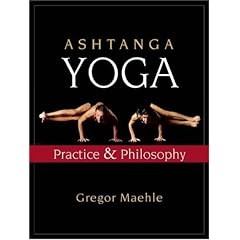 I highly recommend Maehle's Ashtanga Yoga: Practice and Philosophy to any beginner yoga practitioner who is interested in Ashtange yoga and to experienced students as a valuable resource. Not only does it provide the Primary Series asanas with wonderful explanation, it integrates the Yoga Sutras of Patanjali and demonstrates how the eight limbs are practiced within what Maehle calls "the Ashtanga Vinyasa system."
More from the product description (which is accurate): "An extensive explanation of the fundamental techniques of breath, bandhas and drishti is followed by a detailed and comprehensive study of each posture of the Primary Series, following the traditional vinyasa count, complemented by clear and informative anatomical illustrations and descriptions. Additional information on the mythological background and yogic context of specific postures enhances and brings further insight to the practice. Practical tips are also offered. In a discussion of the history of yoga, Gregor Maehle shows how the five-stage unfoldment of mind described in the Yoga Sutra was the key factor in the development of human society during the last five millennia. In a final section of the book, a lively, authentic and practical rendering of the Yoga Sutra, for which the major ancient commentaries have been consulted, lucidly describes the entire path of Ashtanga Yoga and presents it as a realistic path for modern practitioners."
Tuesday, October 14, 2008
An Open Heart
 I was looking for Living Buddha, Living Christ by Thich Nhat Hanh. I had started to read it several months ago but just did not have the time to finish it. I thought now was a good time to try again, but it was out of the library. I asked for it to be held, and in the meantime picked out, An Open Heart, a book by The Dalai Lama that discusses finding compassion in our lives and based on some of his talks given in the Summer of 1999. It is the first Dalai Lama book I will have read, and the first book related to Buddhism since college. I will give more reviews or thoughts later.
Monday, October 13, 2008
Live a yogic life
As I mature in my study of yoga and evolve my perception of life, some things serve as a reminder more than offer inspiration. This week's Words of Wisdom from Sri Swami Satchidananda are like that. I understand what he's saying; I've heard it many times before. But it brings my attention back to the lesson and try to live by the words.
"The real Yoga is not just standing on the head or making the breath like a bellows. They are only aids; they are not the end all. Every action, every minute must be a yogic minute to you. Then you will really enjoy the blessings of Yoga and can call yourself a Yogi. Always see things in this light: Will this give me peace, a balanced mind? All through the day and night, lead a yogic life. Eat in the yogic way, sleep in the yogic way, talk in the yogic way and live in the yogic way. Let us practice Yoga every minute in our daily life."
Asking, "will this give me peace?" is an easy, helpful way to discern what is important in life and provide insight in a difficult situation. Stepping back to ask how to derive peace from a heated discussion or hard decision can provide an answer that stays true to yourself.
Asking, "will this give me peace?" is an easy, helpful way to discern what is important in life and provide insight in a difficult situation. Stepping back to ask how to derive peace from a heated discussion or hard decision can provide an answer that stays true to yourself.
Saturday, October 11, 2008
Sixth Power Yoga Session
It was a cold morning and the studio was not heated up yet, but three ladies showed up to practice the Friday of a long weekend. The students are more comfortable with me now, asking more questions. Since I am not a trained health professional, I have to be careful what I say. I tell them we'll do some poses that help with their ailments, but if the problem persists, to seek a professional. I also reminded them that if the constant vinyasa in between bothers them, they can cut those out of the practice and just work in the postures, holding them longer.
Suryanamaskar A and variations, Suryanamaskar B, Dolphin, Vasisthasana, Utkatasana, Utkatasana w/ twist, Padangustasana, Utthita Hasta Padngustasana, Garudasana (Eagle), Virabhadrasana I & II, Utthita Trikonasana and reverse, Dandasana, Purvottanasana, Janu Sirsasana A & B, Mariachysana, Navasana, Upavishta Konasana, Baddha Konasana, Camel, Paschimottanasana, Supta Padangustasana, Sarvangasana, Matsyasana, Savasana
Tuesday, October 7, 2008
Article: Yoga for Skiers (Yoga Journal)
Another nice article about yoga for skiers. As with the About.com article, these authors touch on the necessary techniques for skiing that can be developed by a regular yoga practice: dexterity, concentration and balance. This article went into more technical detail about each point made earlier.
I think a morning yoga session before they leave for the slopes would focus on warming up the muscles and increasing blood flow--maybe with sun salutations--and some light focus on lengthening (flexibility) of key muscles they will be using that day: opening hips, stretching quads, hamstrings and calves. An "apres ski" yoga session would be less movement, more restorative and focus on alignment, spending more time in poses, using gravity to stretch deeply. Both styles of yoga would take me some time to ensure I offered a well-developed lesson "plan".
- skier angulation overuses hip flexors. If hips flexors are weak, the angular motion and "jarring" can be absorbed by lower back muscles. Skiers with tight hips tend to wrench the upper body, and overuse back muscles, to initiate a turn. Keeping hips supple makes for proper balance and encourages good turning habits
- concentration and awareness of your core is vital to both yoga and skiing. When skiing, your torso and core are faced downhill as your body rises and falls with every turn. Being aware of what your core is doing allows efficient turning techniques and quicker reflexes in unexpected situations.
- check your alignment, stay balanced.
- Feet: shoulder-width apart for a stable base. Tadasana (Mountain Pose).
- Knees: in line with the toes. Utkatasana (Chair Pose).
- Hips: tipped slightly forward. Although an unnatural position for most people, ski boots help encourage this shape in the lower body.
- Shoulders: relaxed. Tadasana.
- Torso: still; a "quiet upper body" is allows the lower body to do most of the work while the upper body provides stability.
- Hands: in front of your body to encourage forward movement and initiate pole plants.
- Feet: shoulder-width apart for a stable base. Tadasana (Mountain Pose).
I think a morning yoga session before they leave for the slopes would focus on warming up the muscles and increasing blood flow--maybe with sun salutations--and some light focus on lengthening (flexibility) of key muscles they will be using that day: opening hips, stretching quads, hamstrings and calves. An "apres ski" yoga session would be less movement, more restorative and focus on alignment, spending more time in poses, using gravity to stretch deeply. Both styles of yoga would take me some time to ensure I offered a well-developed lesson "plan".
Subscribe to:
Posts (Atom)


