In An Open Heart, The Dalai Lama says that things in the physical world come and go by the combined force of causes and conditions. This is evidenced by the fact that we exist. If matter existed without cause, everything would exist eternally in the same state.
He then explained two categories of causes: substantial causes and cooperative causes. Unfortunately, he glosses over substantial causes. I'm taking it to be defined by the causes that happen as a matter of circumstance or internal forces. For instance a seed. A seed has the inner physiology to sprout (substantial cause), but can not do so without external forces. These external forces are cooperative causes, such as sunlight, water, nutrients that cause the seed to sprout.
Then we extrapolate causes onto our state of mind. "The substantial cause of our present state of mind is the previous moment of the mind." Thus, we are where we are in our mind because we put ourselves there. Any stimuli from our senses effect our state of mind and are cooperative causes to our state of mind.
Friday, October 24, 2008

Thursday, October 23, 2008
Subbing
At tonight's skier/rider session, Kathy was feeling particularly energetic. I felt in some ways very tight, maybe still recovering from the weekend, but in other ways felt the energy from Kathy (or within me). I'm menstruating soon, so that may have much to do with my sluggish response.
Anyway, Kathy asked if I were interested in subbing some Intro to Ashtanga classes. I immediately said yes...7:30pm is a great time for me. But after talking to my hubby, methinks I have to work on him a bit.
Anyway, Kathy asked if I were interested in subbing some Intro to Ashtanga classes. I immediately said yes...7:30pm is a great time for me. But after talking to my hubby, methinks I have to work on him a bit.
What comes around...
I forgot to mention that when I opened An Open Heart, a photo fell out. It was a picture of two large, middle-aged men. One is grinning mischievously at the camera while touching the other man's belly. The standing man is barely smiling, more out of being the butt of a joke than fun. The back of the picture reads, "Uncle Ritchie giving birth." I thought it was an odd picture, not one you would expect to see in this kind of book. I also thought how silly it was to leave a picture in a book...
Today, I picked up Living Buddha, Living Christ which came in at the library. I flipped through it, and found another picture. I thought that people ought to be more careful when they return their borrowed books. When I turned the photo over, I was shocked to see it was a picture of my son! I laughed at myself for leaving a photo in a library book. And surprised that it was still there after all of these months.
Today, I picked up Living Buddha, Living Christ which came in at the library. I flipped through it, and found another picture. I thought that people ought to be more careful when they return their borrowed books. When I turned the photo over, I was shocked to see it was a picture of my son! I laughed at myself for leaving a photo in a library book. And surprised that it was still there after all of these months.
Beginning Meditation
Although we wish to be happy and experience bliss, we continue to experience pain and suffering.
In An Open Heart, The Dalai Lama explains that Buddhism teaches that humans engage in things that cause unhappiness and once in the habit of those conditions have a difficult time changing their perspective. Buddhism offers meditation as a means for humans to turn their attention from bad habits to virtuous activities that can lead to a longer-lasting happiness.
In "meditation" we don't mean to sit on a rock by yourself for hours in lotus pose. Meditation is a thought process of contemplating on a subject or object to familiarize and understand deeply about it. This is much like what we do in yoga--still the mind of the fluctuations and focus on one thought.
The meditation that The Dalai Lama suggests to help change attitude can be obtained through the use of two ways: analytical meditation and settled meditation. With analytical meditation, we use the rational process of analysis to get to know our new focus of attention. We devote attention to the subject/object deeply, exploring every facet or it we can think. Once we are familiar with it, we used settle meditation to maintain our sense of closeness. This process is just keeping the object/subject in our thoughts. If we feel we are distancing from it, we may then use analytical meditation to bring us closer again.
Wednesday, October 22, 2008
Finding a guru
As The Dalai Lama explained in An Open Heart, our transformation and spiritual journey is a long one. He suggests finding a spiritual teacher to help guide us. This may take decades to find the right teacher.
I thought about this and realized that the reason I have been struggling with my definition of God is because I have no teacher. It is unfair for me to reject ideas without exploring them with a qualified teacher. I admit that I have let hearsay and flippant translations guide my opinion.
I don't really know where to start looking for a guru, or even if I have time to devote to study with kids, family, home, etc. to manage. I do understand that without it, I will continue to struggle, but then maybe now what I recognize is the need to keep an open mind to everything and try to not pass judgment using bad information.
Three Jewels
I mentioned that I am reading An Open Heart by the Dalai Lama. It's been slow. I read just before bed, which, of course, makes me sleepy. But is calming and gets me ready for sleep. The book is a hard read. You have to want to read it as it will not pull you in.
I am reminded that Buddhists believe in reincarnation. We harbor our emotions and mental experiences from our past lives. As we indulge in afflicting emotions and mental response patterns, they grow stronger and influence our future lives. They cause us to create "mental projections"--and emotional attachment to something, or similarly, repulsion to something. It is this desire of people and things that creates unhappiness.
Spiritual practice will help tame our emotions and mental patterns (whether we have been cultivating them over past lives, or just in this one) and bring us closer to ultimate happiness (bliss--the same state we strive to achieve in the practice of yoga).
One things about Buddhism that bothered me--due to a negative attachment--was the concept of seeking refuge in the Three Jewels: Buddha, his doctrine known as Dharma, and the spiritual community of Buddhists known as the Sangha. I projected this to the Christian concepts of Jesus, Bible and Church. I have no problems with Buddha or Jesus. I begin to have issues when the pure messages are twisted, written down, and preached. And to be told that my soul will be damned if I do not prescribe to one particular society of people's views.
This is why I have been searching for the true meaning of God. Yoga has put me on the right path. I feel like I know the end answer, but getting to that answer is hard to discern. As with any religion, there is the extreme and the malleable. I am hoping that in this book I find help in guiding me on my journey to happiness.
Monday, October 20, 2008
100 things I do that is yoga
Kathy asked us to think of 100 things we do that is yoga. I'm posting it here, will finish as I get around to it.
- Practice asana
- Get a massage
- Read a book to my sons
- Nauli in the morning
- Become aware of breathing
- Cuddle with my sons
- Lay on the couch
- Get a head-pet
- Journal in my blog
- Fold laundry
- Listening to my 4 y/o tell a story
- Use jala neti pot (just you try to think of anything else except the sensation of water shooting out your eyeballs!)
- Chant mantras
- Stare into the fire
- Vacuum
- Knead bread
- Sing to my sons
- Wash dishes
Sunday, October 19, 2008
October workshop - Day three
We opened the day with a presentation on emotional therapeutic yoga. Kathy led us though a vigorous vinyasa class. Then we did more assists.
Trikonasana (triangle pose)
- Standing behind student, press their hips down, grounding the back foot.
- Pull gently up on extended arm
- Also may try using a strap under student's hip and pull from behind
Utthita Parsvakonasana (extended side angle)
- Place foot in front of student's bent foot.
- Pull out on extended arm, lengthening stretch. back foot may come up slightly.
- Make sure thigh is twisting under, hip is twisting up and elbow is twisted under
Paschimottanasana (seated forward bend)
- Help student reach forward by helping press forward from below hump in back
- Press sacrum down
- On student's you know, help spread their hips (reach under each butt cheek and spread out) to align before assisting.
Saturday, October 18, 2008
October weekend - Day two
We started our class off with a traditional Ashtanga class. After practice, Kathy asked us to think about things to do before starting a class.
Prepare for class
Then Kathy reminded us to continue to list 100 things we do that is yoga. For instance, doing dishes is yoga, but doing dishes and listening to the news may not be yoga.
She also reminded us to think of 5-10 things we could eat before a yoga class that would not be too heavy for practicing. (My list from July's workshop)
Kathy is working on a new list of books. Everyone brought in their books. We broke up into groups and made lists.
General comments about assisting (in addition to points from July's workshop):
- From behind student, teacher's heel into the shin of the folded leg of the student; pull back (increasing angle of bent leg)
- Make sure student's spine is aligned with extended leg
- Find the hump of the back, press hands in butterfly shape just below the hump; press forward and down (allowing student's torso to flatten down and out toward extended foot.
- Alternatively, teacher may press one hand down on sacrum/lower back to press buttocks into floor, then use other hand to press torso up and over leg.
Baddha Konasana (bound angle pose)
- If student's knees are high, support with either blocks or your own legs.
- Press sacrum down and help student lean forward
Utkatasana/Virabhadrasana I (fierce pose and warrior one)
For some students, it is not comfortable to let the head hang back with the arms extended upward. Helping straighten the arms eases the pressure on the neck.
- Standing behind student, straighten student's arms by gently rolling elbows in
- In virabhadrasana, you may keep student's arms up while they switch sides
- From Vira-I to II, help student bring arms down, then press your elbows into your sides while helping extend student's arms (shoulder opener).
Prepare for class
- Make sure practice space is clean, warm and smells good
- Ensure music and lighting of room is appropriate
- Have props ready
- Check bathroom
- Have a clock you can see
- Make sure you are clean, emptied bowels/bladder
- Eat two hours before, be hydrated
- Dress comfortably
- Clear mind, focus, steady breath
Then Kathy reminded us to continue to list 100 things we do that is yoga. For instance, doing dishes is yoga, but doing dishes and listening to the news may not be yoga.
She also reminded us to think of 5-10 things we could eat before a yoga class that would not be too heavy for practicing. (My list from July's workshop)
Kathy is working on a new list of books. Everyone brought in their books. We broke up into groups and made lists.
General comments about assisting (in addition to points from July's workshop):
- When assisting, watch your body language--no hands on hips or arms crossed.
- Find a place where you are not making eye contact and are out of the way.
- Bring own towel, but use student's towel on them if they have one, and are particularly sweaty.
- In forward bends, find hump of back and press forward and down just below that hump. Only press above the "hump" on students who are extremely flexible, and just need assistance pressing down
- "The sacrum likes pressure" sometimes pressing down on the sacrum or hips is just enough assisting for tight students. It not only helps stabilize or ground a posture, it just feels good.
- Tucking the chin can help relax tension in the back.
- From behind student, teacher's heel into the shin of the folded leg of the student; pull back (increasing angle of bent leg)
- Make sure student's spine is aligned with extended leg
- Find the hump of the back, press hands in butterfly shape just below the hump; press forward and down (allowing student's torso to flatten down and out toward extended foot.
- Alternatively, teacher may press one hand down on sacrum/lower back to press buttocks into floor, then use other hand to press torso up and over leg.
Baddha Konasana (bound angle pose)
- If student's knees are high, support with either blocks or your own legs.
- Press sacrum down and help student lean forward
Utkatasana/Virabhadrasana I (fierce pose and warrior one)
For some students, it is not comfortable to let the head hang back with the arms extended upward. Helping straighten the arms eases the pressure on the neck.
- Standing behind student, straighten student's arms by gently rolling elbows in
- In virabhadrasana, you may keep student's arms up while they switch sides
- From Vira-I to II, help student bring arms down, then press your elbows into your sides while helping extend student's arms (shoulder opener).
Friday, October 17, 2008
October weekend - Day one
After scrambling to get around the Great Winooski Bridge Mess, I make it to the first day of our workshop 40 minutes late. An energetic six year old flies from the studio front room and into the hallway in front of me. It is Sabian. I ask him about being a ninja for Halloween. He's excited about it. I walk into the front room and look in the studio--everyone is holding their sides and OMing. I recognize the position and for once, am thankful I have been doing these workshops for some time. I relax and talk more with Sabian, a mini-male version of Kathy.
As I enter, we are practicing uddiyana bandha and nauli. Then we list the different types of asana: warmup (suryanamaskars), standing, seated, forward bend, twists, backbend and inversions. We focus on inversions, exercises to get into them and how to assist.
Assists
Adho Mukha Svanasana (downward-facing dog)
- With hands, pressing upward on student's hips.
- With feet, in handstand, lifting up on the student's hips.
Salamba Sirsasana (supported headstand)
- Assist this posture by sitting in front of the student. Place your feet by their elbows. This assist is intimate as your open to their head as they rise to inversion. You place your hands on their hips and can press your head into their back to steady them
- Also assist by standing at an off angle, but secure and steady stance in case the student is off balance. Keep your upper body low to avoid getting clocked in the head by flailing legs. Hands on hips and your shoulder into student's back to steady.
Pincha Mayurasana (feathered peacock pose, i.e. forearm stand)
- Spotter sitting low, pressed into wall. Student's elbows into the arches of spotter's feet. Hold hips as they rise, keep your torso and head low to avoid feet in head. Always hold hips high as they come down to avoid thumping of feet to ground.
- Without a wall, face student in off-stance. Place low hand on shoulder with that same side knee have student's elbow locked into . The higher hand helps student rise. This is good for Scorpion as the legs may come over your back.
Adho Mukha Vrksasana (inverted tree pose, i.e. handstand)
- Spotter low against wall, knees into student's shoulders supporting, and hands under hips to assist rise.
- An exercise for handstands it to attempt a wide-legged handstand. Keep leg high in air and jump up, keepig leg high even as you come down.
Assignments
Kathy wants us to try the following poses in handstand: Baddha konasana, Upavishta konasana, Vrschikasana (scorpion).
Presentation
Kathryn gave her presentation tonight on Yoga and Centered Balanced Riding (horseback riding). She listed resources "Whoa-Ga!", "Yoga on Horseback", and "The Tao of Equus." She also referenced a Yoga Journal article, "Horse Sense" from March 2007.
More Books
The other half of my book order came today. Shambhala Encyclopedia of Yoga by Georg Feuerstein and The Language of Yoga by Nicolai Bachman. Just in time for our workshop! I will give more reviews later.
 Here is the description (very accurate) about the Encyclopedia: "This book is like a World Almanac of Yoga. If you've ever wondered about the names of all the gods and godesses, the meanings of esoteric terms or names of texts you may have come across or the teacher's that started the various schools of yoga and you want an easy way to find out a bit of their history this book is for you. It is both comprehensive and accessible. There are over 2,000 entires covering all aspects of yoga philosophy and traditions, and the explanations are easily understood by most readers, while references are given for those who wish to dig deeper."
 Langugage is a book that defines and provides pronunciation of common yoga sanskrit terms. The description is: "This interactive book-and-2-CD set includes more than 200 asanas with illustrated yoga postures and 300 Sanskrit definitions. It teaches you how to read and pronounce these sacred sounds with precision, and guides you through seven yoga chants with exact rhythm, tone, and pronunciation."
It also gives the complete Ashtanga primary series! Very useful to an Ashtanga student.
 Here is the description (very accurate) about the Encyclopedia: "This book is like a World Almanac of Yoga. If you've ever wondered about the names of all the gods and godesses, the meanings of esoteric terms or names of texts you may have come across or the teacher's that started the various schools of yoga and you want an easy way to find out a bit of their history this book is for you. It is both comprehensive and accessible. There are over 2,000 entires covering all aspects of yoga philosophy and traditions, and the explanations are easily understood by most readers, while references are given for those who wish to dig deeper." Langugage is a book that defines and provides pronunciation of common yoga sanskrit terms. The description is: "This interactive book-and-2-CD set includes more than 200 asanas with illustrated yoga postures and 300 Sanskrit definitions. It teaches you how to read and pronounce these sacred sounds with precision, and guides you through seven yoga chants with exact rhythm, tone, and pronunciation."
It also gives the complete Ashtanga primary series! Very useful to an Ashtanga student.
Thursday, October 16, 2008
Books
Half of my order came in! Light on Yoga by BKS Iyengar and Ashtanga Yoga: Practice and Philosophy by Gregor Maehle.
 Here is my edited description of Light on Yoga: "If you are serious about the physical postures you will love this book. If you are just curious about the range of what is possible this book is where you will find it. In over 600 photos, Iyengar demonstrates all the common poses with a variety of variations and provides detailed instructions for getting into the poses, getting out of the poses, what to expect while in the poses and more. He details the benefits of each pose and suggests what poses are curative for what ailments. The book also offers helpful chapters on pranayama, bhandas and kriyas, and explanations of mudras."
 I highly recommend Maehle's Ashtanga Yoga: Practice and Philosophy to any beginner yoga practitioner who is interested in Ashtange yoga and to experienced students as a valuable resource. Not only does it provide the Primary Series asanas with wonderful explanation, it integrates the Yoga Sutras of Patanjali and demonstrates how the eight limbs are practiced within what Maehle calls "the Ashtanga Vinyasa system."
More from the product description (which is accurate): "An extensive explanation of the fundamental techniques of breath, bandhas and drishti is followed by a detailed and comprehensive study of each posture of the Primary Series, following the traditional vinyasa count, complemented by clear and informative anatomical illustrations and descriptions. Additional information on the mythological background and yogic context of specific postures enhances and brings further insight to the practice. Practical tips are also offered. In a discussion of the history of yoga, Gregor Maehle shows how the five-stage unfoldment of mind described in the Yoga Sutra was the key factor in the development of human society during the last five millennia. In a final section of the book, a lively, authentic and practical rendering of the Yoga Sutra, for which the major ancient commentaries have been consulted, lucidly describes the entire path of Ashtanga Yoga and presents it as a realistic path for modern practitioners."
 Here is my edited description of Light on Yoga: "If you are serious about the physical postures you will love this book. If you are just curious about the range of what is possible this book is where you will find it. In over 600 photos, Iyengar demonstrates all the common poses with a variety of variations and provides detailed instructions for getting into the poses, getting out of the poses, what to expect while in the poses and more. He details the benefits of each pose and suggests what poses are curative for what ailments. The book also offers helpful chapters on pranayama, bhandas and kriyas, and explanations of mudras."
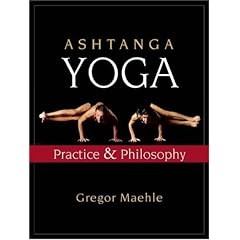 I highly recommend Maehle's Ashtanga Yoga: Practice and Philosophy to any beginner yoga practitioner who is interested in Ashtange yoga and to experienced students as a valuable resource. Not only does it provide the Primary Series asanas with wonderful explanation, it integrates the Yoga Sutras of Patanjali and demonstrates how the eight limbs are practiced within what Maehle calls "the Ashtanga Vinyasa system."
More from the product description (which is accurate): "An extensive explanation of the fundamental techniques of breath, bandhas and drishti is followed by a detailed and comprehensive study of each posture of the Primary Series, following the traditional vinyasa count, complemented by clear and informative anatomical illustrations and descriptions. Additional information on the mythological background and yogic context of specific postures enhances and brings further insight to the practice. Practical tips are also offered. In a discussion of the history of yoga, Gregor Maehle shows how the five-stage unfoldment of mind described in the Yoga Sutra was the key factor in the development of human society during the last five millennia. In a final section of the book, a lively, authentic and practical rendering of the Yoga Sutra, for which the major ancient commentaries have been consulted, lucidly describes the entire path of Ashtanga Yoga and presents it as a realistic path for modern practitioners."
Tuesday, October 14, 2008
An Open Heart
 I was looking for Living Buddha, Living Christ by Thich Nhat Hanh. I had started to read it several months ago but just did not have the time to finish it. I thought now was a good time to try again, but it was out of the library. I asked for it to be held, and in the meantime picked out, An Open Heart, a book by The Dalai Lama that discusses finding compassion in our lives and based on some of his talks given in the Summer of 1999. It is the first Dalai Lama book I will have read, and the first book related to Buddhism since college. I will give more reviews or thoughts later.
Monday, October 13, 2008
Live a yogic life
As I mature in my study of yoga and evolve my perception of life, some things serve as a reminder more than offer inspiration. This week's Words of Wisdom from Sri Swami Satchidananda are like that. I understand what he's saying; I've heard it many times before. But it brings my attention back to the lesson and try to live by the words.
"The real Yoga is not just standing on the head or making the breath like a bellows. They are only aids; they are not the end all. Every action, every minute must be a yogic minute to you. Then you will really enjoy the blessings of Yoga and can call yourself a Yogi. Always see things in this light: Will this give me peace, a balanced mind? All through the day and night, lead a yogic life. Eat in the yogic way, sleep in the yogic way, talk in the yogic way and live in the yogic way. Let us practice Yoga every minute in our daily life."
Asking, "will this give me peace?" is an easy, helpful way to discern what is important in life and provide insight in a difficult situation. Stepping back to ask how to derive peace from a heated discussion or hard decision can provide an answer that stays true to yourself.
Asking, "will this give me peace?" is an easy, helpful way to discern what is important in life and provide insight in a difficult situation. Stepping back to ask how to derive peace from a heated discussion or hard decision can provide an answer that stays true to yourself.
Saturday, October 11, 2008
Sixth Power Yoga Session
It was a cold morning and the studio was not heated up yet, but three ladies showed up to practice the Friday of a long weekend. The students are more comfortable with me now, asking more questions. Since I am not a trained health professional, I have to be careful what I say. I tell them we'll do some poses that help with their ailments, but if the problem persists, to seek a professional. I also reminded them that if the constant vinyasa in between bothers them, they can cut those out of the practice and just work in the postures, holding them longer.
Suryanamaskar A and variations, Suryanamaskar B, Dolphin, Vasisthasana, Utkatasana, Utkatasana w/ twist, Padangustasana, Utthita Hasta Padngustasana, Garudasana (Eagle), Virabhadrasana I & II, Utthita Trikonasana and reverse, Dandasana, Purvottanasana, Janu Sirsasana A & B, Mariachysana, Navasana, Upavishta Konasana, Baddha Konasana, Camel, Paschimottanasana, Supta Padangustasana, Sarvangasana, Matsyasana, Savasana
Subscribe to:
Posts (Atom)


